
Borderline Personality Disorder: Signs, Causes, and Treatment That Actually Works
Borderline Personality Disorder (BPD) is one of the most misunderstood diagnoses in mental health, often reduced to stereotypes in pop culture, and often misdiagnosed or missed altogether in clinical settings. This guide explains what BPD actually looks like day to day, why it develops, and what evidence-based treatment realistically involves.
Note: This article is educational and not a substitute for a professional diagnosis. Only a licensed mental health professional can diagnose BPD after a thorough clinical assessment.
What BPD Actually Feels Like (Beyond the Textbook Definition)
Clinical definitions describe BPD in terms of criteria, but for the person living with it, it often feels like emotions arrive at full volume with no warning, relationships feel simultaneously essential and terrifying, and a sense of who you are can shift depending on who you’re with or how the day is going. It’s exhausting, and it’s rarely something the person chose or can simply decide to stop doing.
Common Signs and Symptoms
Emotional Intensity and Rapid Mood Shifts
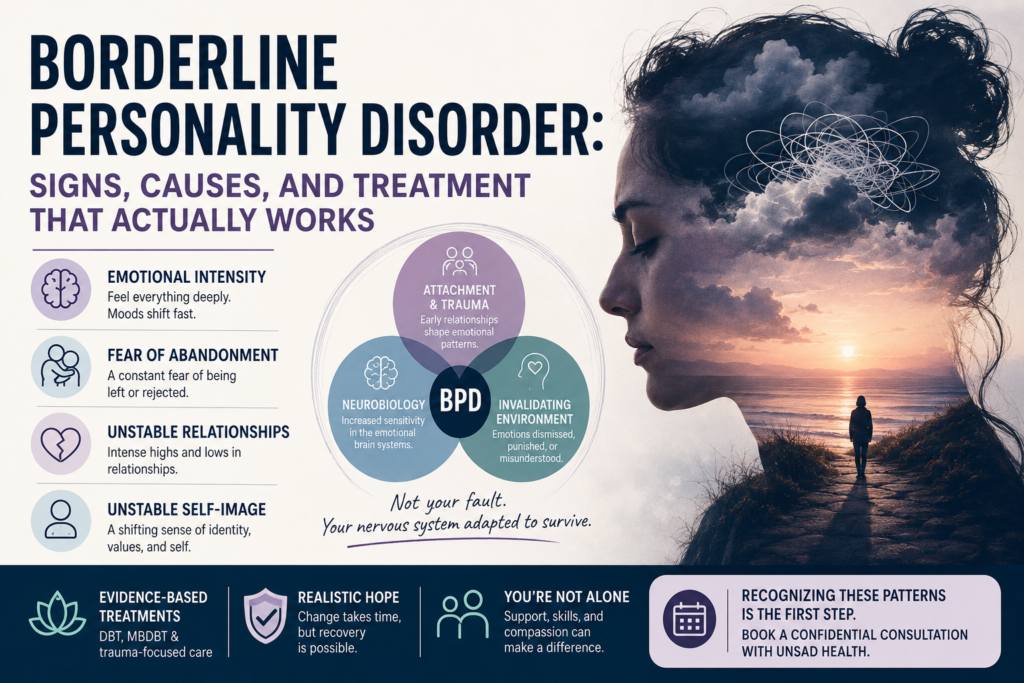
Moods can shift quickly and intensely, from calm to intense anger, sadness, or anxiety, often triggered by something that feels minor to people around them but is genuinely overwhelming internally.
Fear of Abandonment
A persistent, often intense fear of being left or rejected, sometimes leading to actions aimed at preventing abandonment, even in situations where abandonment isn’t actually being threatened.
Unstable Relationships and Self-Image
Relationships often swing between idealization and devaluation, and self-image can feel unstable: a strong sense of identity in one context, and confusion about values, goals, or even personality in another.
What Causes BPD? (Attachment, Trauma, Neurobiology)
BPD is understood to develop from a combination of factors rather than a single cause: a biological sensitivity to emotional stimuli, an invalidating early environment (where emotional experiences were consistently dismissed, punished, or misunderstood), and often, though not always, a history of relational trauma or inconsistent early attachment. None of this means BPD is anyone’s fault; it reflects a nervous system and emotional-regulation system that developed under difficult conditions and adapted the best way it could at the time.
How BPD Is Diagnosed
Diagnosis requires a comprehensive clinical assessment by a licensed psychologist or psychiatrist, typically involving a detailed history, structured interviews, and sometimes standardized assessment tools. BPD is frequently misdiagnosed as bipolar disorder, depression, or anxiety, since symptoms can overlap, which is why an assessment from someone experienced specifically in personality disorders matters.
Treatment Options That Work
DBT and MBDBT
Dialectical Behaviour Therapy was originally developed specifically for BPD and remains one of the most well-supported treatments available. Approaches like MBDBT build on this foundation with an added mindfulness and nervous-system-aware component, which can be particularly helpful for the intense emotional experiences central to BPD.
Trauma-Focused Approaches
Where relational trauma is part of the picture, trauma-focused modalities are often integrated alongside DBT-based skills work to address the underlying wounds, not just the surface behaviours.
Medication’s Role (and Its Limits)
There is no medication specifically approved to treat BPD itself, though medication may be used to manage co-occurring conditions like depression or anxiety. Therapy remains the primary, evidence-based treatment for BPD.
What to Expect From Therapy for BPD
Treatment is typically longer-term rather than a quick fix. Meaningful change often takes months to years, particularly for deeply ingrained relational patterns. Progress is rarely linear; setbacks are a normal part of the process, not a sign that treatment isn’t working. A good therapist will normalize this rather than treating it as failure.
Supporting a Loved One With BPD
If someone close to you has BPD, validation without necessarily agreeing with every interpretation of events is one of the most helpful things you can offer, alongside maintaining your own boundaries. Family or couples sessions can help both sides understand what’s happening and build healthier patterns of communication together.
Frequently Asked Questions
Can BPD be treated without medication?
Yes. Therapy, particularly DBT-based approaches, is the primary evidence-based treatment for BPD. Medication may support co-occurring symptoms but is not a standalone treatment for BPD itself.
Is BPD a lifelong condition?
Many people with BPD see significant, lasting improvement with sustained treatment, and a substantial number no longer meet full diagnostic criteria after several years of therapy. It is treatable, not a fixed life sentence.
How is BPD different from bipolar disorder?
Bipolar disorder involves distinct mood episodes that typically last days to weeks. BPD involves much faster mood shifts, often within hours, usually triggered by interpersonal events rather than occurring independently of external circumstances.
What therapy works best for BPD?
DBT has the strongest research base specifically for BPD. Integrative approaches that combine DBT with mindfulness and trauma-informed care, such as MBDBT, can be particularly effective for clients whose BPD is closely tied to trauma history.
How do I find a BPD specialist in Bangalore?
Look for a licensed clinical psychologist with specific training and experience in personality disorders and DBT-based approaches, not just general counselling experience.
Recognizing these patterns is the first step. Book a confidential consultation with UNSAD Health to talk through what you’re experiencing.