
Why Indian Companies Are Investing in Employee Mental Health Programs in 2026
Employee mental health has moved from a nice-to-have HR initiative to a core business priority for companies across India. This guide is written for HR leaders and founders evaluating whether and how to build a structured mental health program, based on what actually works versus what merely looks good in a benefits brochure.
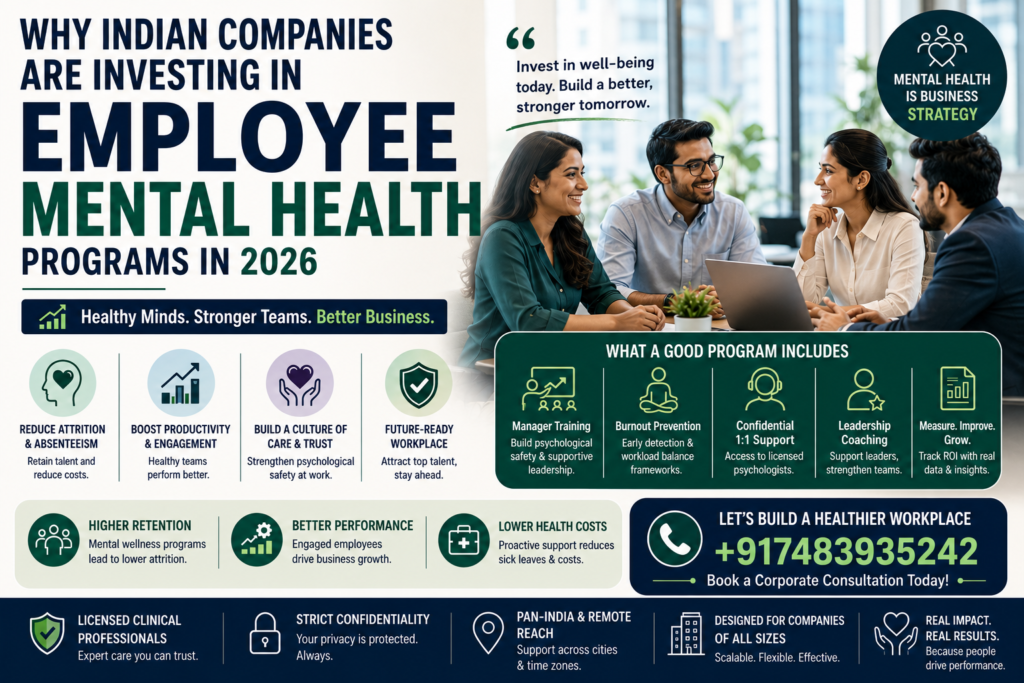
The Business Case (Attrition, Productivity, Absenteeism)
Unaddressed burnout and chronic stress show up in measurable ways: higher voluntary attrition, increased short-term sick leave, disengagement that quietly erodes productivity long before anyone resigns, and higher costs of recruiting and onboarding replacements. For most organizations, the cost of doing nothing is higher, and harder to see, than the cost of a well-designed program.
What’s Changed Since 2020
Remote and hybrid work blurred the boundary between work and home life, and a generation of employees now openly expects employers to take mental health seriously rather than treat it as a private, individual problem. Leadership teams that once viewed this as a soft issue are increasingly treating it as a retention and performance issue with real financial stakes.
What a Good Corporate Mental Health Program Includes
Psychological Safety Training
Programs that train managers, not just employees, to recognize signs of struggle, respond appropriately, and create team environments where people feel safe raising concerns tend to have far more impact than a single all-hands wellness talk.
Burnout Prevention Frameworks
Rather than only offering support after burnout has already occurred, effective programs build in structural checks, such as workload audits, manager training, and early-warning indicators, designed to catch burnout before it becomes a resignation.
Confidential 1:1 Access to Licensed Professionals
Employees need a genuinely confidential route to a licensed psychologist, separate from HR and separate from their manager, with clear communication about what is and isn’t shared with the company.
Leadership/Executive Coaching Components
Leaders often carry disproportionate stress and rarely have anyone to be honest with about it. Executive coaching that addresses the psychological load of leadership, not just management technique, tends to have ripple effects across entire teams.
Common Mistakes Companies Make (Wellness Theater vs Real Support)
A meditation app subscription or an annual wellness week are easy to announce but rarely change outcomes on their own. The most common mistake is treating mental health as a one-off event rather than an ongoing, structural part of how the organization operates, and failing to involve leadership in genuinely modeling the behaviour being promoted.
How to Measure ROI on Mental Health Programs
Useful metrics include changes in voluntary attrition rate, utilization of confidential support services, sick-leave trends, and periodic anonymous surveys on psychological safety and burnout indicators. ROI is rarely visible in a single quarter. Meaningful data typically takes two to four quarters to show a clear trend.
What to Look for When Choosing a Provider
- Licensed clinical professionals delivering the actual therapeutic or coaching work, not just wellness facilitators
- Clear, written confidentiality policies that employees can actually trust
- A program design that includes manager/leadership training, not only individual employee access
- Ability to deliver consistently across multiple office locations or fully remote teams
- A track record working with organizations of similar size and industry
Frequently Asked Questions
What does a corporate mental wellness program typically cost?
Costs vary widely depending on company size, program scope, and whether services are delivered on-site, hybrid, or fully remote. Most providers structure pricing around number of employees covered and depth of services included. It’s worth requesting a tailored proposal rather than comparing generic price lists.
How long does it take to see results from a workplace mental health program?
Early indicators, like utilization rates, can appear within the first quarter. Structural outcomes like attrition and engagement typically take two to four quarters of consistent implementation to show a clear trend.
Is confidentiality guaranteed for employees using these services?
Reputable providers maintain strict confidentiality between individual sessions and the employer, sharing only de-identified, aggregate data such as overall utilization rates, never details of individual employees’ conversations.
Can this be delivered remotely across multiple office locations?
Yes, most well-designed programs today are built to be delivered online, making multi-city or fully remote organizations straightforward to support.
How is this different from a standard EAP (Employee Assistance Program)?
Traditional EAPs often provide limited-session, generic counselling access. A structured corporate mental wellness program typically goes further, including manager training, psychological safety consulting, and leadership coaching alongside individual access to licensed professionals.
Considering a mental health program for your organization? Reach out for a corporate consultation tailored to your team’s specific needs.